

Davie, FL · Sports Performance
Kinesio taping in Davie.
Thin elastic tape applied to the skin by a Doctor of Physical Therapy, used for the feedback and the mild support it gives a sore joint between visits, and honest about being an adjunct inside a plan rather than a treatment of its own.
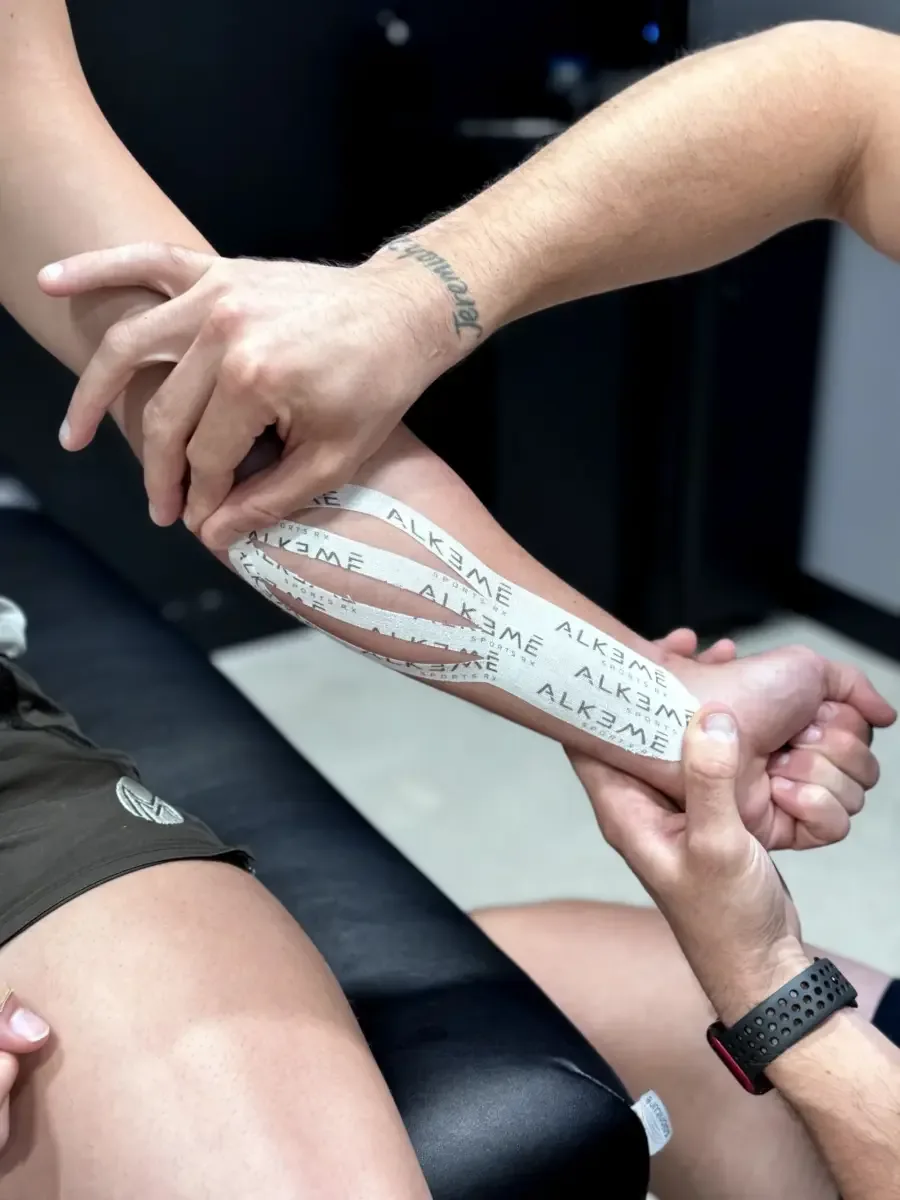
What is kinesio taping in Davie?
Kinesio tape is a thin cotton strip with an elastic weave and an acrylic adhesive, applied to clean skin at varying amounts of stretch. It moves with you, and because it is anchored to skin, it pulls slightly as the joint travels. The two mechanisms that hold up are ordinary ones: cutaneous feedback, meaning you feel the tape and it gives you a running reminder of where that joint is and how it is moving, and mild mechanical support when it is laid in a direction that resists a movement you are trying to limit. It is not switching muscles on, and it is not draining anything.
Tape is mostly a Pain and Perform tool. Early on it is used for comfort and for the reminder, so a sore shoulder or knee is a little easier to live with between visits. Later it appears during return to sport, when you are back on the field and want something on the joint for the last twenty minutes of a game. It is never a phase criterion. Nothing in your progression depends on tape, and if you are advancing only because you are taped, you are not advancing.
Tape is applied by a Doctor of Physical Therapy, at the end of a visit, in a direction and tension chosen for what your evaluation found. It is an adjunct inside a plan, never a treatment on its own. The strength and movement work is what changes the problem. The tape is a helpful accessory that happens to be visible, which is most of the reason it has the reputation it has.
Something to wear between visits.
Tape goes on at the end of the visit for comfort and for the constant reminder it gives a sore joint. It usually stays on two to four days, showers included, and it is doing less work than it looks like it is doing.
Support the range you are rebuilding.
As you start moving better, tape can be laid to resist the direction that still bothers you, which makes the day easier while the strength work catches up. Your doctor adjusts it or drops it as the joint stops needing the cue.
Get through the last twenty minutes.
Returning to a game or a long run, tape often goes on the joint that gets loud late, once the loading work has already earned you the right to be out there. It is a small assist at the end of a hard afternoon, not permission to play.
Taper the tape off.
By the end of a plan most people stop taping, because the joint no longer needs the reminder. Keeping a roll for the occasional heavy week is fine, and needing it every week is a reason to look at the plan again.
What is kinesio taping used for?
Tape is used alongside treatment, on joints that are sore, guarded or on the way back to sport. What it helps with, stated honestly:
Shoulder Pain ⟶
A strip across the upper trap and shoulder gives the running reminder that keeps you out of the shrugged, guarded posture that keeps aggravating it.
02Hip & Knee Pain ⟶
Around a sore kneecap, tape adds a little support and a lot of feedback about where the knee is tracking on stairs and in squats.
03Foot or Ankle Pain ⟶
After a sprain, tape is used for mild support and for the sense of where the ankle is, alongside the balance work that does the real job.
04Tendinitis ⟶
On an irritated tendon, tape can make a working day more comfortable while the loading program gradually rebuilds what the tissue tolerates.
Tape that has been on the same joint for months is usually covering for something: the plan stalled somewhere, and the joint has been managed ever since instead of treated.
What does a kinesio taping application look like?
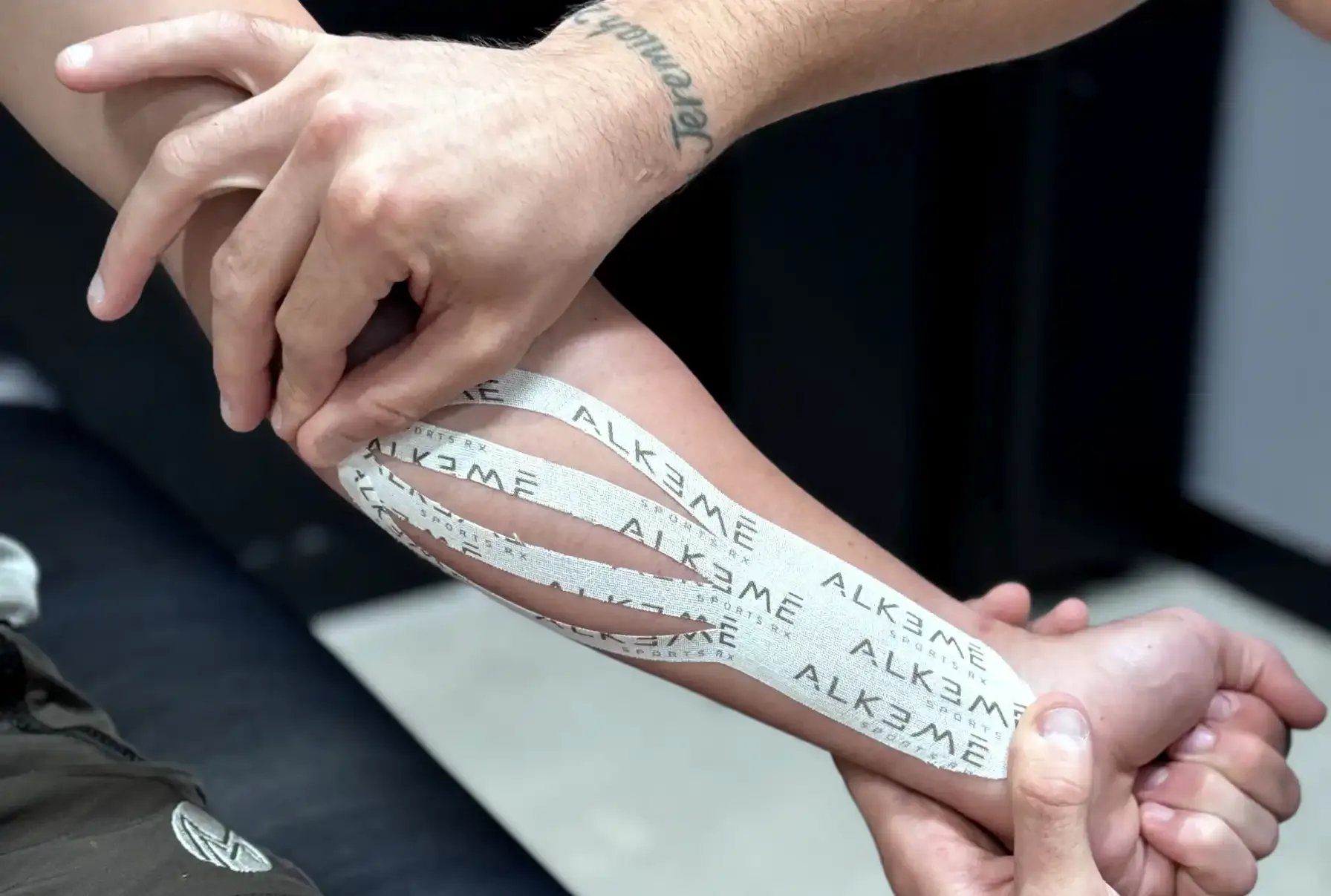
Taping takes a few minutes at the end of a regular visit. Your doctor cleans and dries the skin, shaves the area if it needs it, cuts the strips to length with rounded corners, then lays them down with the amount of stretch the plan calls for, usually with the joint held in a specific position so the tape does its work as you move out of it. The ends go down without tension so they do not lift.
Application does not hurt. Most people feel a light pull on the skin when the joint moves, which is the part actually doing something. The tape stays on two to four days through showers and sweat, the edges start lifting before it stops working, and you peel it off slowly in the direction the hair grows. If the skin gets itchy, red or irritated, take it off and tell us; a reaction to the adhesive is uncommon but not rare.
Who this is for, and who it isn’t.
Taping fits patients with a sore, guarded joint who want something helping between visits, and athletes in the return-to-sport stretch who want a little support and feedback for the part of the game where a joint gets loud. It fits people who understand the scale of what it does and are doing the rest of the work anyway.
Athletes who ask for tape usually saw it on television, on a shoulder or a knee, in colors chosen to be seen from the stands. That is a fine way to hear about a tool. It is worth knowing that the tape on that shoulder was almost certainly the smallest part of what that athlete was doing that week.
It is not appropriate over broken or fragile skin, open wounds, active skin infections or fresh scars, or where there is a known adhesive allergy, and it is never the answer for a joint nobody has evaluated. It is also not right for anyone looking for tape instead of rehab. If tape is the only thing making a joint tolerable, that is a reason to come in, not a reason to buy another roll.
Good fit
- A sore joint that needs a reminder between visits
- Return to sport, for the end of a hard game
- Healthy skin and no adhesive allergy
- You are already doing the strength work
Not the right fit
- Broken skin, open wounds or an adhesive allergy
- A joint that has not been evaluated yet
- Looking for tape instead of a plan
Physical Therapy ⟶
The evaluation and the plan tape is applied inside of, which is the part that actually changes what the joint can do.
02Therapeutic Exercise ⟶
The loading work that builds the tolerance tape is only borrowing against, dosed to the phase you are in.
03Sports Rehab ⟶
The return-to-sport progression where taping usually appears, alongside the criteria that decide when you are actually cleared.
Tape is the accessory, and everything it gets paired with is the reason the joint gets better.
“Best place to get your body back to 100% great staff great work. Got to come check it out!”Quincy Wilson · college football
Questions, answered plainly.
Not in any way that holds up. The claims that survive scrutiny are more modest: the tape gives your skin steady feedback about where a joint is and how it is moving, and laid in a particular direction it offers mild mechanical resistance to a movement you are trying to limit. Those effects are small and they are real. Muscle activation and lymphatic drainage claims are much larger than the evidence behind them, so we do not make them.
Two to four days is typical, including showers, sweat and training. The edges lift before the tape stops doing anything, so once it is peeling at the corners it is finished. Peel it off slowly, in the direction the hair grows, rather than pulling it off fast. If the skin underneath is itchy or red at any point, take it off early and tell your doctor at the next visit.
No, and it is worth being blunt about it. Tape does not build strength, it does not change what a tendon tolerates, and it does not address the reason a joint got sore in the first place. It is applied at the end of a visit as an adjunct to the work that does all three. If tape is the only thing keeping a joint tolerable right now, the plan is the thing that needs attention.
Often yes, and your Doctor of Physical Therapy will show you the placement and the tension if taping is a genuine part of your plan. The parts people get wrong are stretching the ends, applying it to damp or unclean skin, and using far more tension than the application calls for. We will also tell you when to stop, because taping a joint indefinitely is usually a sign the plan stalled rather than a sign the tape is working.
Start with the evaluation, and the tape becomes optional.
Put it in writing.
Five short questions. A real person calls you back, usually within two business hours, with times that fit your week.
The people who end up filling this out are rarely in the worst pain of their life. They’re just done working around it, done picking the errand that doesn’t require the stairs. If that’s the stage you’re at, this is the part where you stop researching and start.
Consider it filed.
A real person will call you back, usually within two business hours, with appointment times that fit your week. Keep your phone nearby.
Can’t wait? Call (954) 800-5826 ⟶Two buildings. Three front desks.
Physical therapy and performance training keep separate phone lines inside the Davie building. Miami is the second address, in the middle of the city.
Physical therapy, Davie · Alkemē Sports Rx
Get Directions ⟶Opens in Google Maps
Performance training, Davie · Alkemē Sports Performance
Get Directions ⟶Opens in Google Maps
The Miami clinic · Alkemē Sports Rx
Get Directions ⟶Opens in Google Maps