

Davie, FL · Sports Performance
Beginner’s fitness in Davie.
A first program for people who have genuinely never trained, or who have not in years: one coach, one plan, and a first session that is mostly a conversation, a movement screen, and about twenty minutes of easy work to find your starting line.
What is beginner’s fitness in Davie?
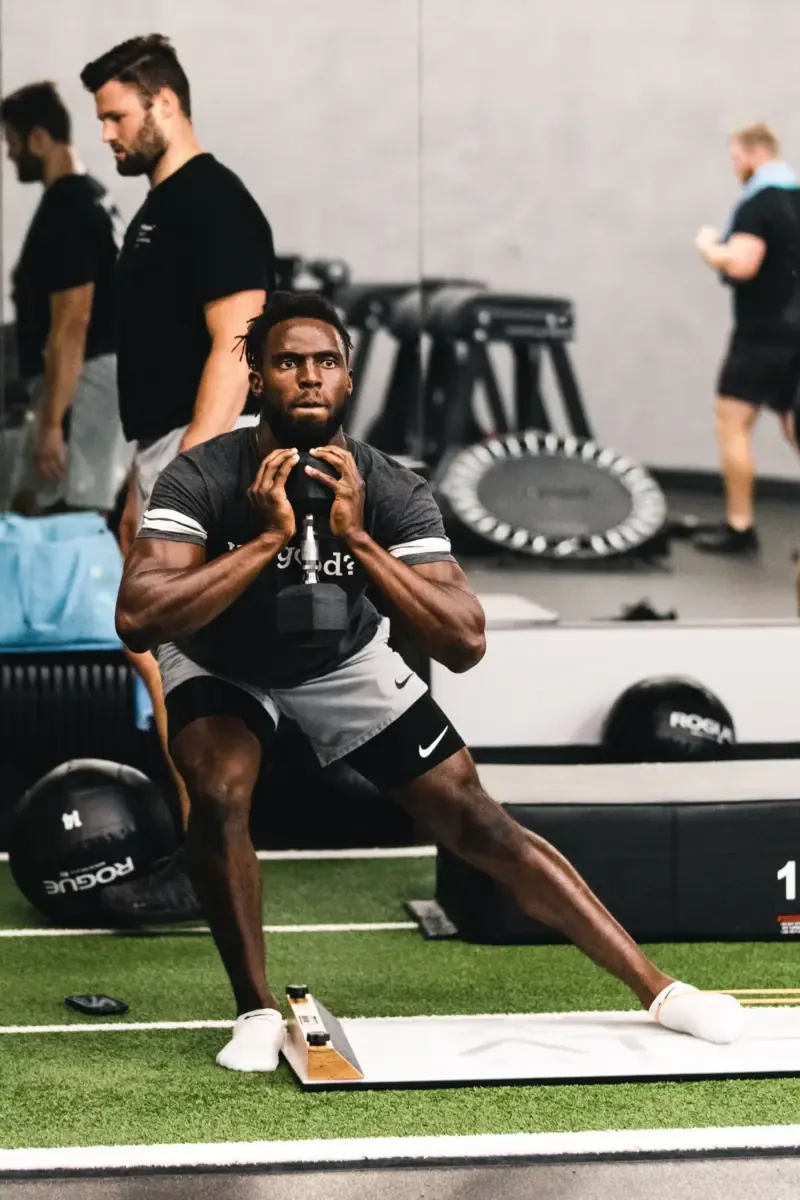
Beginner’s fitness is a structured introduction to training: the six or seven movement patterns everything else is built from, taught one at a time, with load light enough that technique is the only variable in the room. You learn to squat, hinge, push, pull, carry, and get up off the floor without using furniture. The point is not to be tired at the end of the hour. It is to leave knowing what you did and why, and to be able to do it again on Thursday.
It runs through the same four phases as every other plan here, Pain, Prime, Perform and Prevent, just at a different scale. Pain is a screen rather than a treatment: we find anything that hurts and clear it before we load it, which for most beginners is one honest conversation. Prime is where nearly all of the first six weeks live, building positions and the habit itself, and Perform arrives when the patterns hold under real load, not when a calendar says it should.
Your coach is a certified performance coach and the sessions are one-on-one, with a Doctor of Physical Therapy on the same floor when rehab is part of the picture. Nobody is going to shout at you. Coaching a beginner is mostly correction and patience, and the training is one tool inside a plan that also involves walking, sleeping, and eating like somebody who trains.
Find out what hurts first.
Before anything gets loaded we go joint by joint and ask a plain question: does this hurt, and when. Most beginners have one or two answers, and knowing them on day one is what keeps week three from going sideways.
Learn six movements well.
The first weeks are squatting, hinging, pushing, pulling, carrying and getting off the floor, coached with light load and a lot of feedback. Progress here looks like better positions rather than bigger numbers, and that is the correct thing to be pleased about.
Add load once the pattern holds.
When a movement looks the same on the last rep as it did on the first, weight starts going on it. That is usually somewhere between week four and week eight, and it is decided by what your coach sees rather than by the date.
Make it a habit you keep.
The plan is built around the number of days you can genuinely commit to, including the weeks when work gets loud. A program you keep at two days a week beats a program you abandon at five, every time.
What does beginner’s fitness help with?
Starting from nothing tends to fix a short list of things quietly, and it also means working around whatever you are already carrying. A sample:
Joint Pain ⟶
Joints that ache from disuse usually feel better with graded loading than with more rest, once the painful ones have been screened.
02Back Pain & Sciatica ⟶
Learning to hinge and brace properly gives a back a way to lift a laundry basket that is not a gamble.
03Chronic Pain ⟶
Predictable, gently progressing activity is one of the more reliable ways to widen what a sensitive body will tolerate.
04Balance Therapy ⟶
If standing on one leg or getting off the floor is genuinely hard, that gets addressed directly rather than trained around.
The cost of not starting is rarely dramatic: it is a year in which the stairs got slightly worse, sleep got slightly worse, and the gap between what you can do and what you would like to do widened without anyone mentioning it.
What does a first session actually look like?
You arrive in clothes you can move in. The first fifteen minutes are a conversation: what you have done before, what hurts, what your week really looks like, and what you actually want out of this. Then a movement screen, which is your coach watching you squat, reach overhead, balance on one leg and get up off the floor, with no grade attached to any of it.
After that you train, for roughly twenty to thirty minutes, at an effort you could hold a conversation through. Usually that is a light goblet squat, a hinge with a dumbbell, a push, a pull and a carry, six or eight reps each, two or three rounds. You leave with the plan on paper and a clear answer to what next week asks for. You should not be sore enough to regret it.
Who this is for, and who it isn’t.
This is for people who have genuinely never trained, and for people who used to and have not in five, ten or twenty years. It is for anyone who has walked into a commercial gym, looked at the free weight area, and walked back out to the treadmill. It is also a reasonable first step after a long illness, a desk-bound decade, or a pregnancy, once you have been cleared to exercise.
Most people who book this are not lazy and know it; they are competent adults who are good at nearly everything else in their lives and have simply never been taught this one thing, which is a teaching problem rather than a character problem.
It is not the right room for someone with current, undiagnosed pain, or for anyone still inside a surgeon’s restrictions after an operation. Cardiac history, uncontrolled blood pressure and dizziness all get screened before a session is booked. If the honest answer is that you need a physician or a Doctor of Physical Therapy before a coach, we will tell you that rather than sell you a package.
Good fit
- Never trained, or not in years
- Wants to be taught, not just tired
- Coming back after time off or illness
- Prefers one coach to a crowded class
Not the right fit
- Current pain that hasn’t been evaluated
- Still under post-operative restrictions
- Chasing rapid weight loss in a few weeks
Fitness Training ⟶
Once the patterns hold and the habit is real, general conditioning is the usual next block.
02Small Group Fitness ⟶
Some beginners keep the habit better with two or three other people expecting them on a Tuesday.
03Strength Training ⟶
When you want the numbers themselves to start climbing, structured loading is what that turns into.
Almost nobody stays a beginner for long, and the job of this block is to make the next one obvious.
“Best place to get your body back to 100% great staff great work. Got to come check it out!”Quincy Wilson · college football
Questions, answered plainly.
No, and that loop is the reason this page exists. The first session establishes your actual starting point and the program begins there, at an effort you can repeat rather than one you can survive. Plenty of people start at twenty minutes of light work twice a week. That is a real beginning, not a placeholder.
Some, especially after the first two or three sessions, and it usually arrives a day later and settles within two. Your coach doses the early weeks specifically to avoid the kind of soreness that ends a program in its second week. If you are too sore to move normally, that is information: it means we went too fast, and it changes the next session.
Clothes you can move in, closed shoes with a reasonably flat sole if you have them, and water. You do not need lifting shoes, a belt, gloves, or any equipment of your own. Arrive about five minutes early for the first visit, since the paperwork and the conversation both happen before anything physical does.
Two to three sessions a week is typical, and it is the range most beginner blocks here are built around. Two is genuinely enough to make progress if it is consistent. Your coach will build the plan around the days you can actually commit to, including the weeks you already know will be difficult, rather than around an ideal schedule nobody keeps.
Start where you actually are.
Put it in writing.
Five short questions. A real person calls you back, usually within two business hours, with times that fit your week.
The people who end up filling this out are rarely in the worst pain of their life. They’re just done working around it, done picking the errand that doesn’t require the stairs. If that’s the stage you’re at, this is the part where you stop researching and start.
Consider it filed.
A real person will call you back, usually within two business hours, with appointment times that fit your week. Keep your phone nearby.
Can’t wait? Call (954) 800-5826 ⟶Two buildings. Three front desks.
Physical therapy and performance training keep separate phone lines inside the Davie building. Miami is the second address, in the middle of the city.
Physical therapy, Davie · Alkemē Sports Rx
Get Directions ⟶Opens in Google Maps
Performance training, Davie · Alkemē Sports Performance
Get Directions ⟶Opens in Google Maps
The Miami clinic · Alkemē Sports Rx
Get Directions ⟶Opens in Google Maps