

Davie, FL · Sports Performance
Basketball rehab in Davie.
Rehab built around what basketball actually asks of a body: landing on one leg, decelerating out of a cut, and doing both again in the third game of a weekend, with the return decided by testing rather than by how the ankle feels walking.
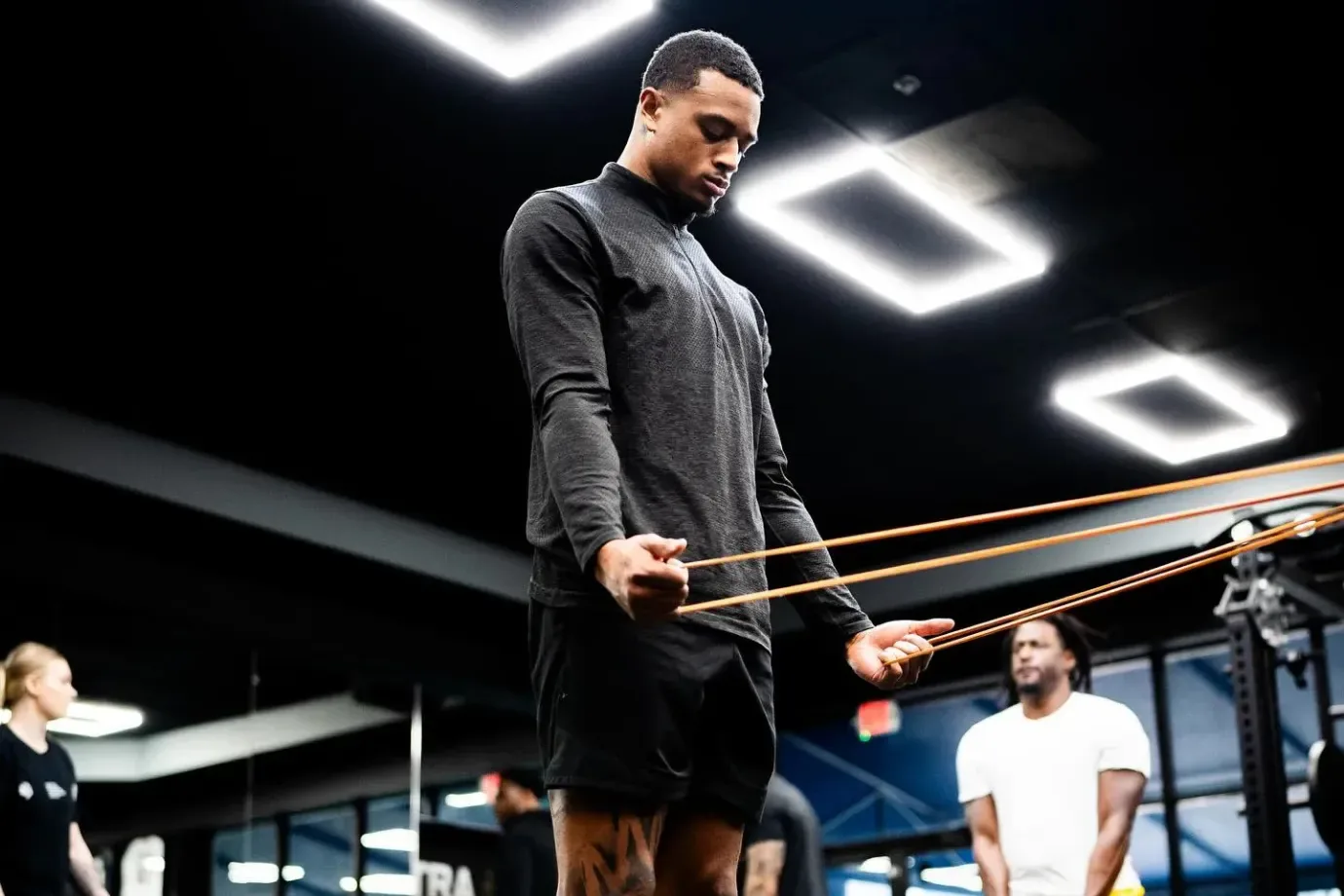
What is basketball rehab in Davie?
Basketball rehab is the program, not the diagnosis. The injuries themselves, the rolled ankle, the sore patellar tendon, the ACL, are explained on our basketball injuries page. This one is about the rehab that follows, built around jumping, landing and cutting, because those are the three moments a basketball player is actually rehabbing for.
Every plan here runs Pain, Prime, Perform and Prevent in that order, and basketball rehab spends most of its time in the last two. Pain and Prime settle the tissue and rebuild single-leg strength. Perform rebuilds the landing on purpose, one leg at a time, then at speed, then off a rebound with somebody bumping you. Prevent deals with the ankle that has now been sprained three times, the most common story told in this room.
The program is run one-on-one by a Doctor of Physical Therapy who watches how you land rather than counting how many you did. The honest constraint on this page is volume: no rehab plan survives a high school season stacked on an AAU schedule with nothing subtracted.
Settle the joint, keep the season alive.
Early work protects the injured tissue while conditioning and upper-body training continue, so you are not starting from zero on the day you are cleared. Hands-on treatment starts at the evaluation, and swelling and range usually move first.
Single leg, then single leg tired.
Prime rebuilds calf, quad and hip strength on one leg, because basketball almost never asks for two. Testing hunts for the side-to-side gap that a normal walking gait hides completely.
Rebuild the landing, then the cut.
Perform teaches the landing before it allows the jump: two feet, then one, then off a step, then off a rebound with contact. Deceleration and change of direction come last, because that is where the knee is most exposed and the tissue has to be ready to absorb it.
Fix the ankle that keeps rolling.
Prevent is balance, calf endurance and ankle strength that continue in season, not for two weeks after discharge. It also includes an honest conversation about how many games a week the body in front of us can currently handle.
What does basketball rehab treat?
Basketball rehab is the program we build once a basketball injury has been evaluated. A sample of what it commonly follows:
Basketball Injuries ⟶
The category itself: what happened, why it happened on that particular landing, and what has to be rebuilt.
02Foot or Ankle Pain ⟶
The lateral ankle sprain that healed enough to play on and never got its balance and calf strength back.
03Tendinitis ⟶
Patellar tendon pain that warms up in the first ten minutes of practice and is worse the next morning.
04ACL Tear ⟶
The long program, where the knee has to prove it can decelerate before anyone discusses a game.
An ankle that was never fully rehabbed rarely stays an ankle problem: the calf stops trusting the surface, the knee starts absorbing what the ankle used to, and the next sprain arrives in a season that mattered more.
What does a basketball rehab session look like?
Sessions run 30 to 60 minutes, one-on-one with the same Doctor of Physical Therapy each visit. Early on it looks like therapy: hands-on work at the ankle or the knee, then calf raises, split squats and isometrics loaded to what the tissue tolerates that day.
Later it looks like a workout that happens to be supervised. You jump, you land, you get watched landing, and your doctor stops the set when the knee starts drifting inward rather than when the count runs out. Hop testing and force plate numbers are repeated on the same equipment, so the number that clears you is comparable to the one you started with.
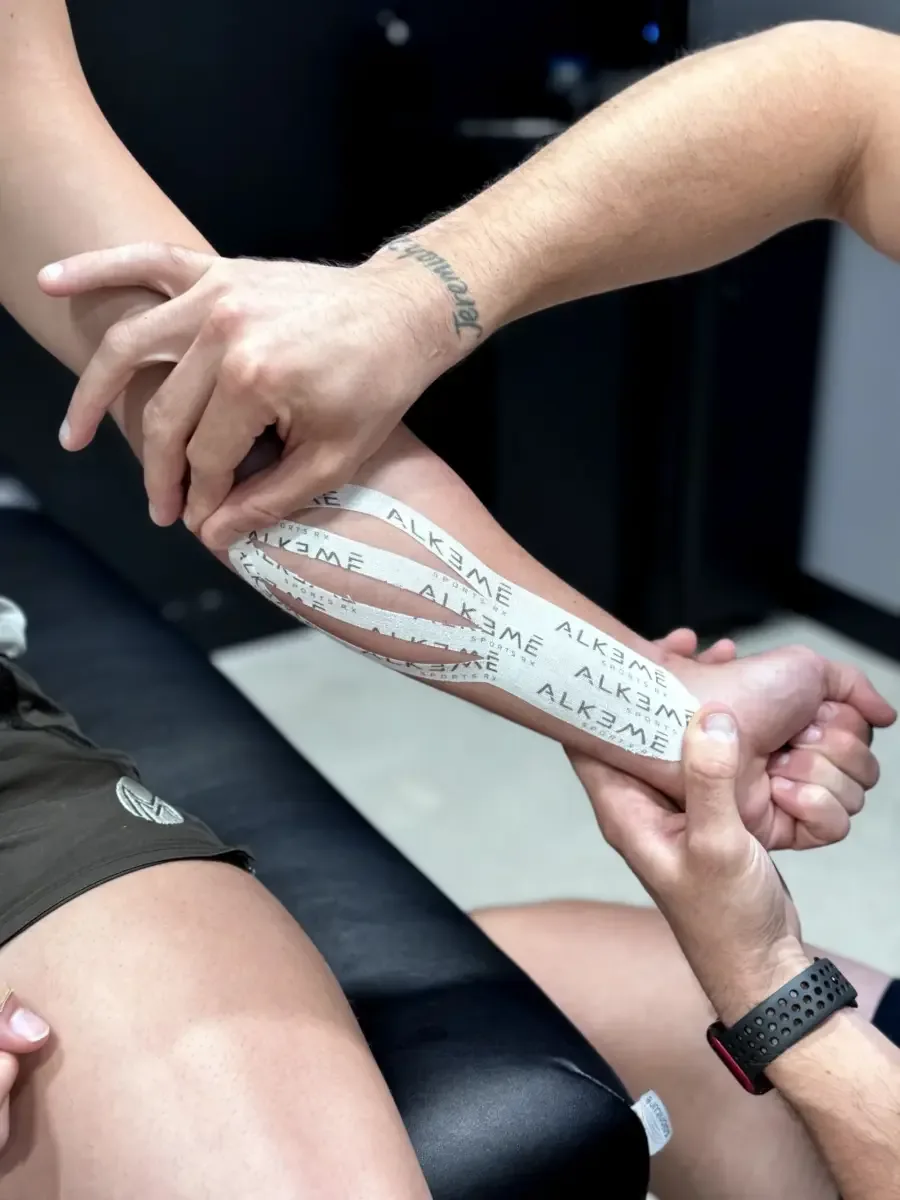
Who this is for, and who it isn’t.
Basketball rehab fits the player whose injury happened in a basketball moment: a landing, a closeout, a step on somebody else’s foot. Most of this room is high school and club players and their parents, plus adults still playing three nights a week. The clinic has worked with NBA and NCAA athletes, and a fifteen-year-old’s program is built on the same criteria.
If you are the parent reading this, you are already weighing rehab against missed games, and you probably suspect the honest answer involves subtracting some of the schedule. You are not wrong, and it is a better question than most people bring through the door.
It is not for a player who wants to be taped and sent back out. It is also not the right first stop for a knee that locks or gives way without warning, an ankle that cannot bear weight, or a suspected fracture. Those get screened at the evaluation and sent for imaging or a physician’s opinion before we build anything.
Good fit
- A third ankle sprain in two seasons
- Knee pain that only shows up on landings
- Post-surgical and building back to a court
- Playing school ball and AAU the same year
Not the right fit
- A knee that locks or gives way unexplained
- Suspected fracture, not yet imaged
- Wanting a brace and clearance, nothing else
VALD Performance Testing ⟶
Force plate and dynamometry numbers that show whether the injured leg is still doing less work on a landing.
02Balance & Coordination ⟶
The ankle proprioception work that decides whether the next roll becomes another sprain.
03Agility Training ⟶
Where cutting and deceleration work continue once rehab has finished with them.
04Blood Flow Restriction ⟶
A way to keep quad strength moving while the knee still can’t take heavy load.
Because performance training runs on the same floor, the move from your last rehab session to your first training block is a conversation between two people who have both watched you land.
“My teenager son plays soccer competitively in a high performance setup, he recently had a fracture that required physical therapy. Thanks to the professionalism and knowledge of Alkemē Sports RX he was able to rehabilitate in the correct way to be able to return to training with his team.”Mario K. · parent
Questions, answered plainly.
It depends on the tissue and on what the testing shows, not on a set number of weeks. A lateral ankle sprain is often a few weeks of rehab; an ACL reconstruction is a program measured in months, with criteria at every stage. For the more common injuries, sessions typically run 30 to 60 minutes, two to three times a week for four to six weeks, and your evaluation gives you the specific criteria that move you from Perform into Prevent.
Usually because the first sprain healed enough to play on before balance, calf endurance and ankle strength came back. The ligament stabilizes, but the reactions that catch a bad landing stay slower than they were, so the second sprain takes less force than the first. Rehab here retrains that reaction deliberately, on one leg, tired, and carries it into the Prevent phase rather than stopping when the swelling does.
Often yes, but something usually has to be subtracted, and we will say so plainly. A high school season stacked on an AAU schedule leaves very little room for tissue to adapt, which is why patellar tendon pain tends to appear in the players with the most games. We build the plan around the games that matter most to the family, and that conversation happens at the evaluation, before you commit to anything.
No referral. Florida allows direct access to physical therapy, and state law allows 30 days of treatment before a referral is required. You do not need imaging to start either, though the evaluation screens for the findings that should send you to a physician first, and we say so the same day if we see them. We are in-network with Tricare at Davie, accept out-of-network benefits from all insurers, and have self-pay rates due at time of service.
Start with the evaluation that watches you land.
Put it in writing.
Five short questions. A real person calls you back, usually within two business hours, with times that fit your week.
The people who end up filling this out are rarely in the worst pain of their life. They’re just done working around it, done picking the errand that doesn’t require the stairs. If that’s the stage you’re at, this is the part where you stop researching and start.
Consider it filed.
A real person will call you back, usually within two business hours, with appointment times that fit your week. Keep your phone nearby.
Can’t wait? Call (954) 800-5826 ⟶Two buildings. Three front desks.
Physical therapy and performance training keep separate phone lines inside the Davie building. Miami is the second address, in the middle of the city.
Physical therapy, Davie · Alkemē Sports Rx
Get Directions ⟶Opens in Google Maps
Performance training, Davie · Alkemē Sports Performance
Get Directions ⟶Opens in Google Maps
The Miami clinic · Alkemē Sports Rx
Get Directions ⟶Opens in Google Maps